
Hope Is the Thing With Feathers
On transformation, happy endings, and Swan Lake's surprising political history
With its grand score, virtuosic choreography, and ethereal dancers, Swan Lake is regarded as one of the most famous ballets of all time, second only to The Nutcracker. But beneath its beautiful surface, the ballet has a complex history. The original work, which premiered in 1877 in Moscow, was considered an absolute failure; its successful revival by Marius Petipa and Lev Ivanov came almost two decades later. Through the years, it transformed into the bastion of elegance, strength, and beauty we know today — but in Russia, it also became a symbol of war, death, and political unrest.
Swan Lake is a story about young love, but it’s also a story about control. The young prince Seigfried feels bound by duty and obligation and wants nothing more than to pursue his beloved, Odette. Odette has no autonomy; captured and controlled by von Rothbart, she is cursed to live as a swan by day. The young protagonists’ desires are simple: they want love, acceptance, and freedom. In most versions, the couple only finds that freedom in death. But in other interpretations, including Louisville Ballet’s, the lovers defeat Rothbart and live happily ever after. The Bolshoi Ballet’s version also features a happy ending — one that’s complicated by its status as a coded political signal.
In 1982, after the death of Soviet leader Leonid Brezhnev, state television stations aired the Bolshoi’s Swan Lake on a loop. For days, moonlit swans flooded TVs without explanation. This bizarre broadcast was deployed again in 1984 and 1985, after the deaths of Brezhnev’s successors Yuri Andropov and Konstantin Chernenko, and in 1991, after the failed coup against Mikhail Gorbachev.
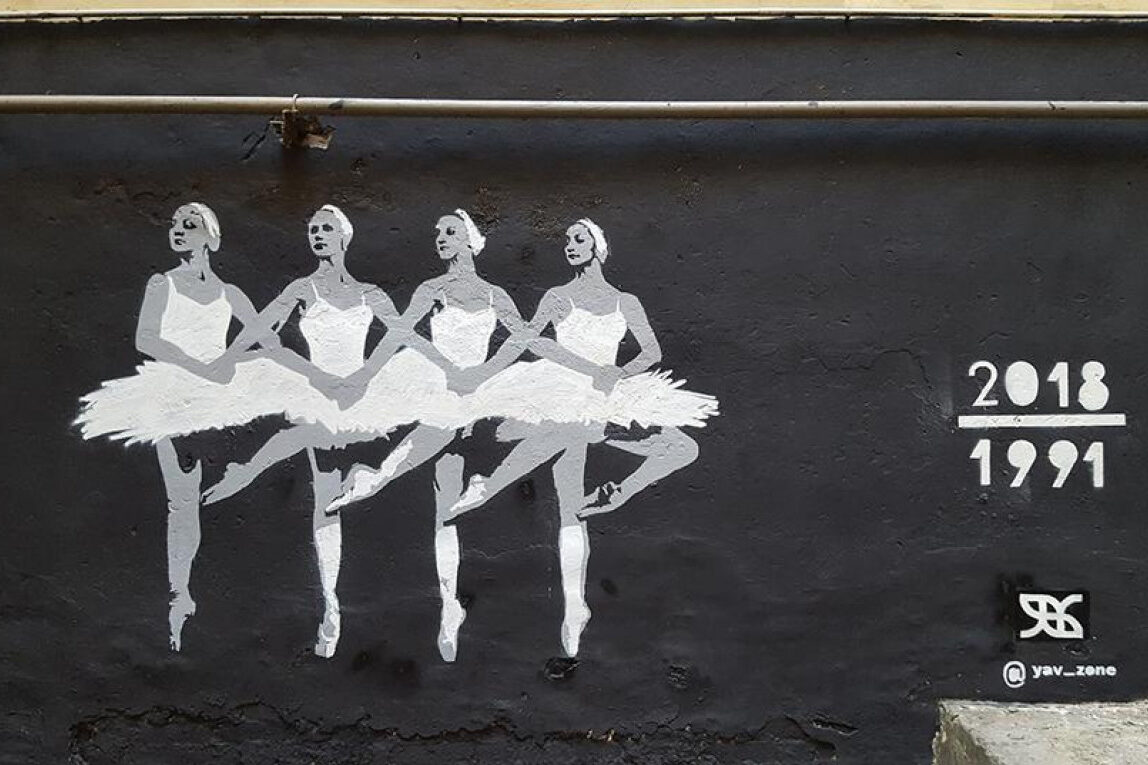
Thus, the graceful ballet came to symbolize political upheaval and the death of Soviet leaders. In 2018, graffiti artists protested Vladimir Putin’s fourth inauguration by tagging a wall with the iconic four interlinked swans, reclaiming the ballet’s iconography as an act of resistance. After Russia invaded Ukraine in 2022, more swans decorated city walls. And when an independent TV station was banned for its coverage of the invasion, they chose Bolshoi Ballet’s infamous recording as their final broadcast.
When asked why she choreographed a happy ending to our version, Senior Rehearsal Director Mikelle Bruzina said, “I want the audiences to believe in true love and to leave with hope for the future.”
Swan Lake teaches us that transformation is always possible: An idea that was deemed a failure is now world-famous. Art used by the government to suppress is now used by the people to resist. An ending known for tragedy is now full of promise. The poet Emily Dickinson wrote that hope “is the thing with feathers / That perches in the soul / And sings the tune without the words.” Perhaps this wordless performance of Swan Lake will stay with you and offer you what you need most — whether that’s an escape, a moment of inspiration, or a reminder of the enduring power of hope.
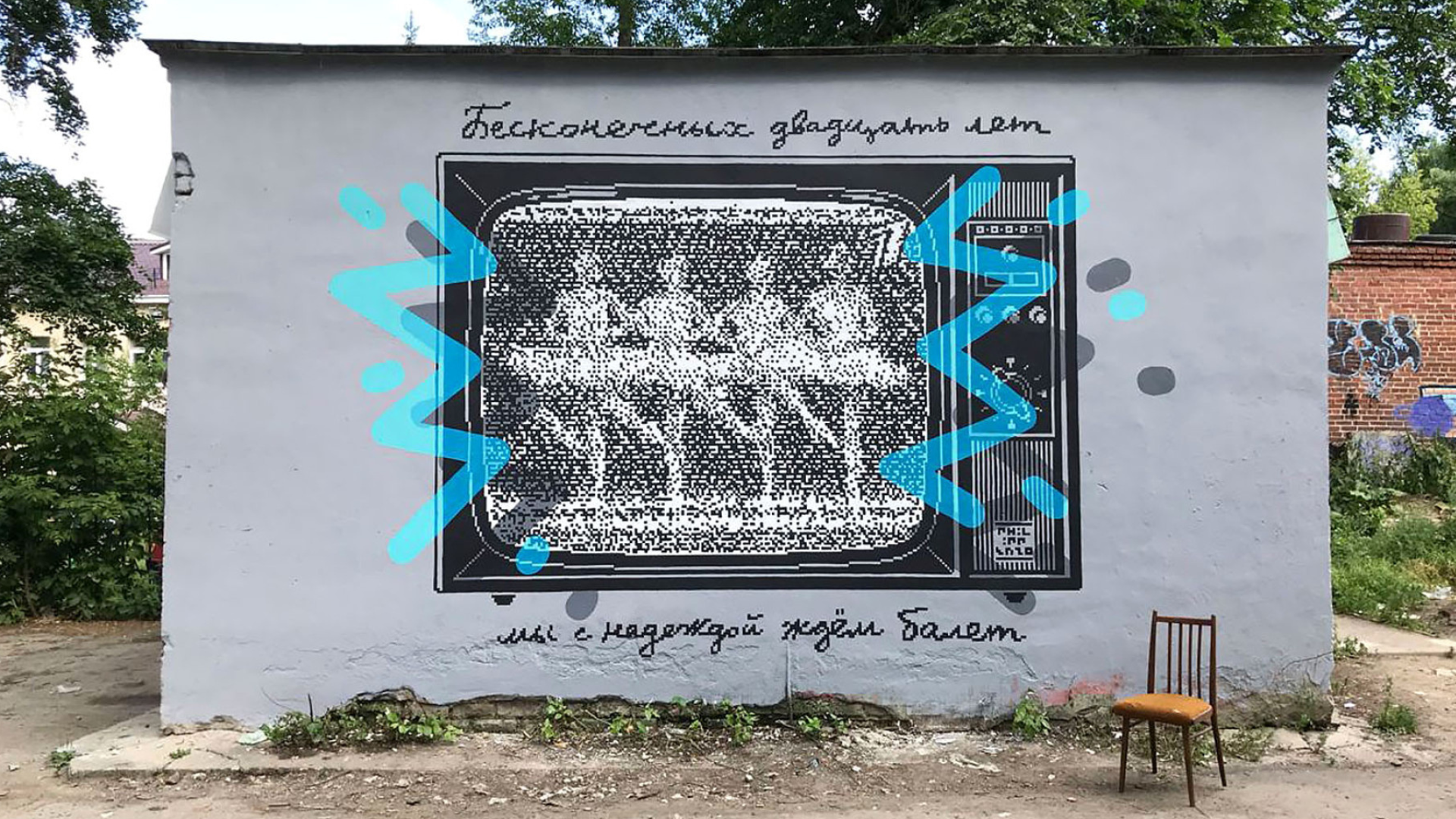
Photo: Street art in Yekaterinburg, Russia, by the artist Philippenzo
Hope is the thing with feathers
That perches in the soul,
And sings the tune without the words,
And never stops at all,
And sweetest in the gale is heard;
And sore must be the storm
That could abash the little bird
That kept so many warm.
I’ve heard it in the chillest land,
And on the strangest sea;
Yet, never, in extremity,
It asked a crumb of me.
–Emily Dickinson, 1891
Featured photo: Street art in St. Petersburg, Russia, by Yav Art Group.
Sources: